
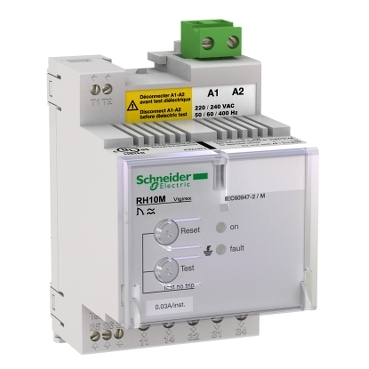
Description
The RH10M Earth Leakage Relay (also referred to as VigiPacT RH10M / Vigirex RH10M) is designed to enhance safety in power distribution systems by detecting dangerous leakage currents that could indicate earth faults, insulation failures, or shock hazards. Installed on a DIN rail inside switchboards, it continuously monitors the connection between the relay and an associated earth‑leakage toroid or sensor (e.g., Schneider VigiPacT TOA, RH A, or L type sensors). When the sensed residual (leakage) current exceeds the fixed sensitivity threshold (such as 30 mA, 100 mA or 300 mA, depending on the variant), the relay activates its output to trip a breaker, interrupting the circuit to protect people and equipment.
The RH10M typically has a fixed “Type A” earth‑leakage setting (responding to AC and pulsating DC residual currents) with instantaneous trip behavior (no adjustable delay). It includes manual reset after fault clearance, local and remote test functions, and continuous monitoring of electronics and power supply health. The relay complies with relevant IEC/EN standards for residual current devices and protection relays and supports multiple earthing systems such as TN‑S, IT, and TT.
📊 Specifications Table
| Specification | Details |
|---|---|
| Product Name / Series | RH10M Earth Leakage Relay (VigiPacT / Vigirex) |
| Function | Residual current (earth leakage) protection relay |
| Protection Class | Type A earth‑leakage (AC + pulsating components) |
| Sensitivity (IΔn) | Fixed per model (e.g., 30 mA, 100 mA, 300 mA) |
| Trip Response / Delay | Instantaneous (no adjustable time delay) |
| Supply Voltage (Us) | Typical variants: 220–240 V AC; 380–415 V AC; also lower voltage versions exist (e.g., 110/130 V AC or 24 V supplies) |
| Rated Power Consumption | ~4 VA |
| Monitored System Voltage | Up to 1000 V AC 50/60 Hz / 400 Hz max |
| Compatibility | Requires associated earth‑leakage current sensor / toroid (e.g., VigiPacT TOA, RH A, RH L) |
| Mounting | DIN‑rail (EN/IEC standard) |
| Reset Type | Manual reset after trip |
| Test Function | Local and remote test available |
| Relay Output | Normally one contact set (typically change‑over contact) – used to trip breaker or alarm |
| Thermal Current (Ithe) | ~8 A conventional enclosed thermal current |
| Minimum Load | ~10 mA @ 12 V |
| Mechanical / Environmental | IP20/IP30/IP40 depending on surface; robust to vibration, IK07 protection rating on front, fire resistance per IEC60695‑2‑1 |
| Weight | ~0.3 kg |
| Standards / Approvals | IEC/EN 60947‑2 annex M, IEC/EN 60755, IEC 60364; EMC standards IEC 61000 etc. |
🧠 Key Features & Benefits
-
⚡ Earth leakage monitoring: Detects dangerous residual currents (earth faults) that standard overcurrent devices may miss.
-
🛡️ Protection integration: Triggers circuit breaker trip via external releases (e.g., shunt or breaker trip coil) when leakage exceeds threshold.
-
🔁 Continuous monitoring: Monitors power supply, sensor link, and internal electronics for reliability.
-
🧪 Test and reset functions: Allows local and remote testing and manual reset for safe maintenance.
-
📏 Wide earthing system support: Works in TN‑S, IT, TT systems.
-
🔌 DIN‑rail mounting: Easy to install in control panels and switchboards.
📌 Typical Applications
✔ Residual current protection for industrial and commercial switchboards
✔ Fire and shock protection systems
✔ Motors and sensitive equipment earth fault protection
✔ Coordination with circuit breakers for fast disconnection
✔ Networks up to 1000 V AC systems

Reviews
There are no reviews yet.